
Article: How to Buy a Preloved Luxury Bag Safely in the Philippines
How to Buy a Preloved Luxury Bag Safely in the Philippines
By the Purse Maison Editorial Team — reviewed by Miss Jay-Ann. Last reviewed: July 12, 2026.
In 2024, Philippine authorities seized a record ₱40.99 billion worth of counterfeit goods, a 52% jump from the year before, and apparel, shoes, and bags led the categories. A single July raid in Binondo alone hauled ₱11 billion in counterfeit luxury items.
If you are thinking about your first preloved luxury bag and part of you hesitates, that hesitation is not paranoia. It is good judgment. The preloved market in the Philippines has matured enormously; it is now possible to buy a Chanel Classic Flap or an Hermès Birkin here with genuine confidence. But the difference between a safe purchase and a painful one usually comes down to what you check before you pay, not after.
This guide walks through the entire journey: the seller, the item, its condition, authentication, payment, physical inspection, delivery, and aftercare. Use it with any reseller, including us.
Key Takeaways
- Vet the seller before you evaluate the bag. Track record, physical presence, verified channels, and a written authenticity guarantee matter more than any single photo.
- No single feature proves a bag is authentic. Authentication is an evaluation of many characteristics together, and reputable sellers say so openly.
- Pay only through traceable channels tied to the business, never to a random personal account, and never under time pressure.
- Whenever the value is high, see the bag in person before completing the purchase, or buy from a seller who makes that possible.
- Safe buying does not end at payment: check the bag immediately on delivery, keep every document, and store it properly for the Philippine climate.
Why Caution Is the Correct Starting Point
Globally, trade in counterfeit goods reached an estimated USD 467 billion (about 2.3% of world trade) according to the most recent OECD–EUIPO analysis of customs seizure data, and clothing, footwear, and accessories such as handbags sit among the most-counterfeited categories.
The uncomfortable local truth is that the Philippines is part of that picture. The record 2024 seizures were not obscure products; they were led by exactly the categories a bag buyer cares about.
The quality of fakes has also changed. Market reporting in recent years has described so-called “superfakes”: counterfeits produced with materials and construction good enough to challenge quick visual checks that might have worked a decade ago. The practical lesson is not fear. It is that shortcuts — a screenshot of a receipt, a single “authenticity card,” a confident seller — are no longer enough on their own. A safe purchase is built from several layers of proof, and each section below is one layer.
Step 1: Vet the Seller Before You Evaluate the Bag
Most bad purchases are not caused by a buyer misreading stitching. They are caused by trusting the wrong seller. Before you fall in love with an item, ask these questions about whoever is selling it:
- Do they have a track record you can inspect? Years of activity, consistent listings, and reviews across platforms. Follower counts alone prove little, since followers can be bought.
- Do they have a physical presence? A registered business with a showroom you can visit puts real accountability behind every transaction. An account that exists only in DMs can disappear overnight.
- Are you talking to the real account? Impostor pages that copy a legitimate reseller’s name and photos are a common scam pattern. Verify the exact handle against the seller’s official website before sending money. (Purse Maison, for example, lists its only verified Instagram and Facebook accounts on pursemaison.com; anything else using the name is not us.)
- Do they offer a written authenticity guarantee? Look for a clear, stated policy, not a verbal assurance. Our own policy is simple: if an item is ever proven inauthentic, you receive 100% of your money back.
- How do they respond to hard questions? A trustworthy seller welcomes questions about provenance, condition, and returns. Defensiveness or urgency (“someone else is about to buy it”) is a signal to slow down.
Step 2: Demand Proof for the Item Itself
Once the seller passes, turn to the specific bag:
- Complete, current photographs: all sides, corners, base, interior, hardware engravings, and date stamps or serial markings where applicable. Stock photos or images lifted from other listings are a red flag.
- The stamping and serial context, explained honestly. Brands mark their bags in different ways across eras. Chanel, for instance, moved from serial stickers to embedded microchips in 2021, which is why you will see “microchip” noted on newer pieces in our Chanel collection. A knowledgeable seller can tell you what marking this specific bag should carry for its production period. Be cautious with anyone who treats a serial number alone as proof, because codes can be copied.
- Inclusions, listed precisely. Dust bag, box, authenticity card, receipt: valuable, but understand what they are. They are accessories that support the picture, not proof. Counterfeiters reproduce cards and receipts too.
- A written condition description that matches the photos. More on this next.
Step 3: Read Condition Like a Professional
Condition is where preloved buying most often disappoints, and usually not because of fakes but because of surprises. Protect yourself by asking:
- What is the seller’s condition grade, and what does it specifically mean?
- Are all flaws photographed: corner wear, hardware scratches, interior marks, odors?
- Has the bag been repaired, restored, or recolored? By whom?
- Does the price reflect the condition, compared with similar pieces on the market?
A seller who documents flaws honestly is showing you how they will treat you after the sale. At Purse Maison, our returns policy is built around exactly this: undisclosed flaws or missing inclusions reported within 48 hours are grounds for return. That only works because disclosure is the standard in the first place. Condition is also one of the six forces that set every bag’s price; our guide on what makes one luxury bag more expensive than another explains the rest.
Step 4: Understand What Authentication Can (and Cannot) Promise
This is the section where honest sellers and dishonest ones sound most different.
No single card, receipt, serial number, sticker, plate, stitch count, stamp, smell, code, or physical feature can independently prove authenticity. Authentication requires evaluating multiple characteristics together.
Details vary by model, material, factory, and production period, and counterfeit techniques change over time. That is why a credible evaluation examines many characteristics together: stamping, hardware, stitching, materials, construction, serial markings, and how they all agree with the bag’s stated production period. It is also why professional authentication is recommended for any high-value purchase, and why educational articles (including this one) should never replace a formal expert opinion.
What you can reasonably expect from a serious reseller:
- a described, multi-point inspection process (ours covers stamping, hardware, stitching, and serial markings, among other characteristics);
- honest language, meaning “this is consistent with authentic production” rather than “this code proves it’s real”;
- a money-back guarantee that puts the financial risk of authenticity on the seller, not on you.
Step 5: Pay in Ways That Protect You
However convinced you are, let the payment method be the skeptic:
- Pay only through channels tied to the registered business. Never pay a personal account under a different name, and never split payment across several unexplained accounts.
- Get the price, item description, and terms in writing before paying. An invoice or order confirmation, not just a chat message.
- Prefer traceable methods. Bank transfer to a verified business account, card payment, or an established checkout (such as the seller’s own online store) all leave a paper trail. Untraceable cash handoffs to strangers do not.
- Never pay under time pressure. Manufactured urgency is the single most common thread in payment scams. A legitimate bag that sells while you take a day to verify is a small loss; the alternative can be a large one.
- Beware of “reservation fees” demanded through DMs by accounts you have not fully verified. This is where impostor-account scams typically strike.
Step 6: See the Bag in Person Whenever Value Is High
Photographs compress reality. Weight, smell, the feel of the leather, the sound of the hardware, the trueness of the color: these are physical facts best confirmed physically.
This is why we consider a physical showroom part of buyer safety, not a luxury. At the Purse Maison showroom (1601 One Park Drive, Bonifacio Global City, Taguig — open 10AM–6PM), you can hold the exact piece, examine every disclosed flaw, compare it against others, and take your time. At the time of writing, for example, a Chanel Classic Double Flap Medium in black caviar leather with gold hardware, a microchip-era piece, is available to view in person; the current price is on the listing.
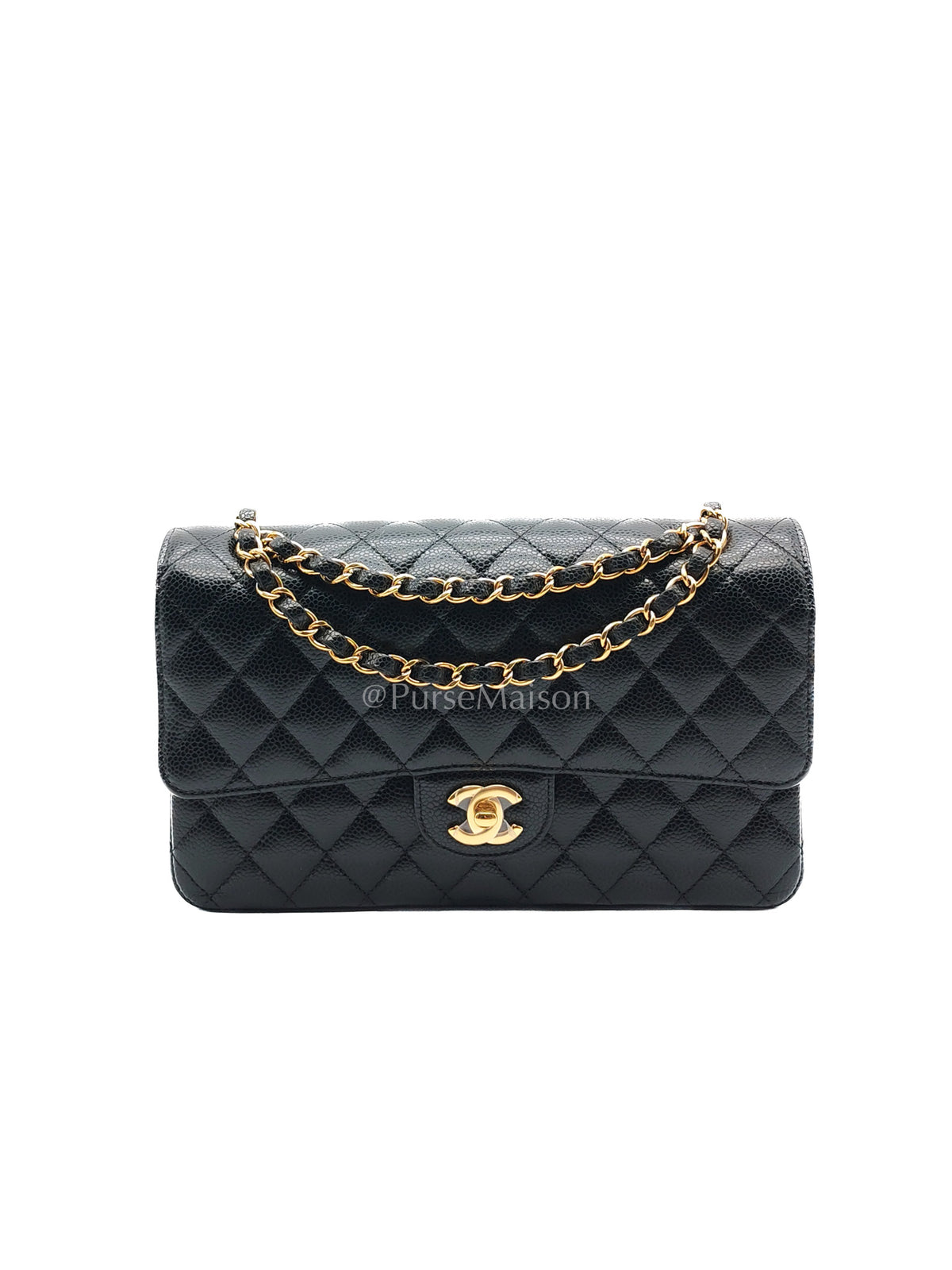
If an in-person visit is impossible, ask for a live video call with the bag in hand. A seller with nothing to hide will show you anything you ask to see.
Step 7: Protect the Purchase After You Pay
Safe buying continues through delivery and into ownership:
- Inspect immediately on arrival. Check the item against the listing photos and inclusion list the day it arrives. At Purse Maison, concerns about undisclosed flaws or missing inclusions must be raised within 48 hours, with the security tag intact. Most reputable resellers have similar windows, so do not let a delivered box sit unopened for a week.
- Keep everything. The listing, the invoice, the chat history, the inclusions, any authentication documentation. This is your bag’s paper trail: it protects you now and supports resale value later.
- Store it for our climate. Philippine humidity is unkind to leather. Keep the bag stuffed to hold its shape, in its dust bag, away from direct sunlight, in a ventilated space (ideally with silica gel or a dehumidifier nearby), and check it regularly for early signs of mold.
Who This Checklist Is For
If you are buying a preloved luxury bag for the first time, or you have been browsing for months but hesitating, this process is for you. It matters most for high-value pieces from the most-counterfeited houses: Chanel, Hermès, Louis Vuitton, Goyard, Dior. For lower-priced contemporary brands the stakes are smaller, but the habits are identical, and they cost you nothing but a little patience.
Experienced collectors will recognize most of this. What changes for them is scale: the higher the value, the less any single proof should be trusted alone, and the more the in-person inspection and the seller’s guarantee matter.
The Purse Maison Verdict
Buying preloved luxury in the Philippines is safe when the process is safe. The market has real risks — record counterfeit seizures and increasingly convincing fakes are documented facts, not sales talk — but every one of those risks has a practical countermeasure: a vetted seller, item-specific proof, honest condition disclosure, multi-characteristic authentication backed by a guarantee, traceable payment, physical inspection, and disciplined aftercare.
No checklist can reduce risk to zero, and no honest seller will tell you otherwise. But a buyer who follows these seven steps has removed the openings that nearly all bad outcomes exploit. The bag should be a joy. The process should be boring. That is what safety looks like.
The Safe-Buying Checklist
The seller — verifiable track record · physical showroom or registered business · official, verified accounts · written authenticity guarantee · welcomes hard questions
The item — complete current photos · correct markings for its production period · inclusions listed precisely · flaws disclosed in writing
The transaction — terms in writing · traceable payment to the business · no urgency, no unverified “reservation fees”
The handover — in-person viewing (or live video) before high-value purchases · immediate inspection on delivery · all documents kept
The aftermath — return window understood · humidity-conscious storage · regular condition checks
Frequently Asked Questions
Is it safe to buy luxury bags online in the Philippines? Yes, from the right seller and with the right process. The risks are real (the Philippines recorded ₱40.99 billion in counterfeit seizures in 2024), but they concentrate around unverified sellers, untraceable payments, and purchases made under pressure. The seven steps above address each one.
Does an authenticity card or receipt prove a bag is real? No. Cards and receipts support the overall picture but are themselves reproduced by counterfeiters. Authenticity rests on many characteristics of the bag evaluated together, which is why a seller’s inspection process and money-back guarantee matter more than any paper insert.
Should I pay a reservation fee to hold a bag? Only to a seller you have fully verified, through a traceable channel tied to the business, with the terms in writing. Reservation-fee requests through DMs from unverified accounts are a common scam pattern in the Philippines.
What should I do the day my bag arrives? Open it immediately, compare it against the listing photos and inclusion list, and raise any discrepancy at once. At Purse Maison the window for undisclosed flaws or missing inclusions is 48 hours with the security tag intact; other resellers have their own windows, so know yours before you buy.
Can Purse Maison help me even if I’m not ready to buy? Yes. Education before pressure is how we prefer to work. Ask an advisor anything, or visit the showroom just to look and learn.
Ready to see how this feels in practice? Book a private viewing at our BGC showroom or ask a Purse Maison advisor: no pressure, no obligation. If you would rather browse first, explore our authenticated Chanel, Hermès, and Louis Vuitton collections.
Purse Maison is an independent luxury reseller and is not affiliated with or endorsed by the brands discussed unless expressly stated. This article is educational guidance, not a substitute for professional authentication of a specific item. Market figures are stated as of the dates indicated and may change.
Sources
- OECD–EUIPO, Mapping Global Trade in Fakes 2025 (published May 2025; 2021 customs data): oecd.org press release · EUIPO publication page — checked July 12, 2026
- IPOPHL, NCIPR seizes record ₱40.99 billion counterfeit goods in 2024 (Feb 6, 2025): ipophil.gov.ph — checked July 12, 2026
- BusinessWorld, Seizures of counterfeit goods hit ₱41 billion in 2024 led by apparel, shoes, bags (Feb 6, 2025): bworldonline.com — checked July 12, 2026
- South China Morning Post, Inside the rise of the superfake handbag: scmp.com · Robb Report, The Surge of ‘Superfake’ Handbags: robbreport.com — checked July 12, 2026
- Chanel’s 2021 transition from serial stickers to embedded microchips: verified across multiple industry sources — checked July 12, 2026
- Purse Maison policies (authenticity guarantee, returns, showroom): pursemaison.com/pages/faqs — checked July 12, 2026

Leave a comment
This site is protected by hCaptcha and the hCaptcha Privacy Policy and Terms of Service apply.